
For electronics manufacturers, purchasing a rework machine is not simply a matter of comparing equipment prices. A BGA repair process involves controlled heating, precise component positioning, solder removal, replacement, and reflow. If the equipment cannot maintain the required thermal profile or alignment accuracy, the result may be board warpage, damaged components, poor solder joints, or repeated rework.
This is why B2B buyers should develop a technical equipment specification before comparing suppliers. Instead of starting with questions such as “What is the BGA rework station price?”, manufacturers should first define board dimensions, package size, heating requirements, positioning accuracy, production volume, and automation level.
Seamark ZM provides a range of rework equipment, from hot-air and infrared systems to optical-alignment and fully automatic BGA rework platforms. Its product range allows different production environments to be matched with different equipment architectures.
The first technical specification should be the physical working range.
A manufacturer should record:
Maximum and minimum PCB dimensions
Maximum and minimum BGA package dimensions
Board thickness and construction
Component height around the rework area
Required working area for fixtures
Weight and rigidity of the PCB
These parameters determine whether a compact rework station machine is sufficient or whether a large-board platform is necessary.
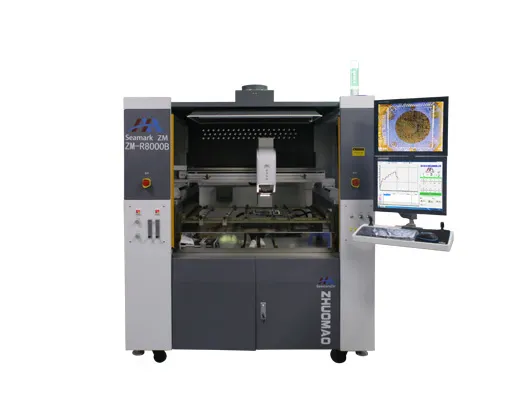
For example, Seamark's ZM-R8000B is designed as a large precision rework station. Its published specifications include a maximum PCB size of 800 × 660 mm and a BGA size range from 2 × 2 mm to 80 × 80 mm.
This illustrates an important purchasing principle: equipment capacity should be evaluated against the largest real production board, not the average board.
Heating technology is one of the most important differences between rework machines.
A hot air BGA rework station transfers heat through controlled airflow, while an infrared system uses infrared radiation to heat the work area. Neither approach is universally better; the correct choice depends on PCB structure, component size, thermal mass, and process requirements.
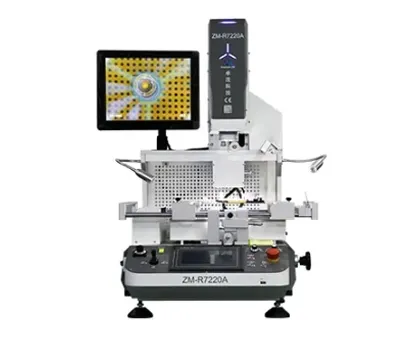
For applications requiring infrared heating, the Seamark ZM-R7220A is an infrared soldering station equipped with an IR preheating zone, top and bottom heating, real-time temperature monitoring, and optical alignment. Its IR preheater uses a medium-wave ceramic infrared heating plate.
For manufacturers processing different PCB designs, the ability to control heating zones can be more important than the nominal heater power.
A useful procurement specification should therefore identify:
1. Heating method
2. Top-heater capacity
3. Bottom-heater capacity
4. Preheating area
5. Independent heating zones
6. Temperature measurement points
7. Cooling capability
8. Available process-profile control
Temperature control directly affects soldering quality.
A rework system must heat the target area sufficiently to achieve solder reflow while limiting thermal stress on the PCB and nearby components. Simply specifying maximum temperature is therefore inadequate.
Buyers should examine how the machine measures and controls temperature.
A suitable system should provide:
Thermocouple feedback
Closed-loop temperature control
Real-time temperature display
Programmable heating profiles
Repeatable heating performance
Process monitoring and recording where required
The ZM-R7220A, for example, uses K-type thermocouple closed-loop control and provides real-time temperature monitoring with automatic curve analysis. Its published temperature-control accuracy is up to ±3°C.
For higher-end production environments, this information is much more useful than comparing heater wattage alone.
Another critical specification is component positioning.
BGA packages contain multiple solder connections underneath the package, so positioning accuracy is essential during replacement. A machine may have excellent thermal control but still produce poor results if the component cannot be aligned accurately.
An optical alignment system can help operators or automated mechanisms position the component relative to the PCB pads.
The Seamark ZM-R7220A uses a 2-megapixel digital imaging system, automatic optical zoom, and a laser red-dot indicator. Its published alignment accuracy is ±0.02 mm.
For higher-volume production, buyers should additionally determine whether alignment is:
Manual
Assisted
Semi-automatic
Fully automatic
This distinction can have a major effect on operator dependency and production repeatability.
Not every factory needs a fully automatic system.
A repair laboratory, prototype department, or low-volume electronics manufacturer may prioritize flexibility and operator control. A high-volume EMS facility, however, may benefit from automatic positioning, feeding, heating, and process execution.
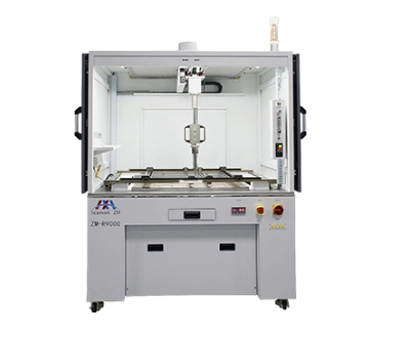
Seamark's portfolio ranges from manual-control systems to fully automatic visual-alignment equipment. The ZM-R8650C, for example, is described as a fully automatic visual-alignment BGA rework station for automatic placement and soldering of chip devices on large PCB boards.
The procurement decision should therefore consider:
Low volume: flexibility and easy setup may be more important.
Medium volume: optical alignment and repeatable thermal profiles become increasingly valuable.
High volume: automation, recipe management, process consistency, and integration should receive greater priority.
This approach prevents manufacturers from paying for automation they will not use—or purchasing a low-automation machine that becomes a production bottleneck.
A common mistake is evaluating a machine only according to its PCB capacity.
The physical installation requirements also matter.
Before ordering a BGA machine China manufacturers or international suppliers, engineering teams should verify:
Machine footprint
Electrical requirements
Exhaust or ventilation requirements
Operator access
PCB loading direction
Fixture clearance
Maintenance access
Factory environmental conditions
Integration with existing equipment
For example, the ZM-R7220A requires AC220V ±10%, 50/60 Hz and has published maximum power consumption of 5.65 kW.
Such specifications should be included in the factory acceptance checklist before equipment shipment.
Searching for BGA rework station price can provide a starting point for market research, but purchase price alone does not represent the actual cost of ownership.
A lower-priced machine may require more manual intervention, longer setup times, additional fixtures, or more frequent operator adjustment.
A technical cost evaluation should include:
Initial equipment cost
Tooling and fixture cost
Nozzle requirements
Installation
Training
Preventive maintenance
Calibration
Consumables
Operator labor
Downtime
Expected service life
For a production factory, the relevant metric is ultimately cost per successfully reworked board rather than the equipment's initial quotation.
A rework machine should not be evaluated independently from quality verification.
After BGA rework, manufacturers may need to verify solder-joint quality using X-ray inspection, especially when the joints are hidden underneath the package.
This creates a useful equipment architecture: rework → inspection → process feedback.
Seamark ZM supplies both BGA rework systems and microfocus X-ray inspection equipment, allowing manufacturers to consider these processes as part of a broader PCBA quality-control strategy. Its product portfolio includes offline, inline, and industrial 3D/CT X-ray systems.
For engineering teams, the important question is not merely whether the rework machine can replace a component. It is whether the complete process can demonstrate that the repaired board meets the required quality criteria.
Modern B2B production increasingly requires process records.
For automated or high-value electronics manufacturing, buyers should determine whether the rework system needs to record:
Product or board identification
Rework recipe
Temperature profile
Operator information
Process time
Component information
Alignment results
Inspection results
This becomes particularly important in automotive electronics, telecommunications equipment, industrial controls, aerospace electronics, and other applications where repair history may need to be documented.
Data capability should therefore be included in the original purchasing specification rather than treated as an optional software feature.
Industrial equipment selection should also include lifecycle requirements.
Preventive maintenance for X-ray machines is important when an X-ray inspection system is used after rework, but rework equipment itself also requires regular inspection of heaters, thermocouples, fixtures, optical systems, vacuum components, and mechanical positioning mechanisms.
For X-ray systems used as part of the verification process, buyers should establish an X-ray machine preventive maintenance schedule and define calibration or performance-verification intervals according to manufacturer recommendations and applicable requirements.
Safety documentation should also be reviewed before installation. For cabinet X-ray systems, IEC 61010-2-091 specifies particular safety requirements.
Once technical requirements have been established, suppliers can be compared objectively.
A practical evaluation matrix can include:
Category | Key requirement |
PCB capacity | Maximum board size and thickness |
BGA range | Minimum and maximum package size |
Heating | Top, bottom, IR or hot air |
Temperature | Closed-loop control and profile capability |
Alignment | Optical system and positioning accuracy |
Automation | Manual, semi-automatic, or automatic |
Fixtures | Standard and customized options |
Inspection | Compatibility with X-ray verification |
Data | Recipe and process traceability |
Maintenance | Service and calibration support |
Safety | Applicable documentation and safeguards |
Total cost | Equipment + tooling + operating cost |
This approach is more reliable than comparing machines based on one specification such as heater power or BGA rework station price.
For B2B buyers, the value of a supplier is not limited to supplying one machine.
Seamark ZM's product portfolio covers BGA rework stations, infrared soldering equipment, microfocus X-ray inspection machines, battery X-ray inspection systems, SMD component counting equipment, and automated optical inspection systems.
This broader portfolio can be useful when manufacturers are building a complete electronics quality-control workflow rather than purchasing an isolated rework station machine.
The best purchasing strategy is therefore to define the process first, translate it into measurable technical specifications, test representative boards, and then compare suppliers against the same acceptance criteria.
Start with PCB dimensions, BGA package size, heating method, temperature-control accuracy, optical alignment, automation level, fixture requirements, production volume, maintenance, and total cost of ownership.
Not necessarily. Infrared and hot-air systems use different heating methods. The appropriate choice depends on PCB construction, component geometry, thermal requirements, and the manufacturer's process.
It is highly important because BGA solder joints are located underneath the package. Accurate alignment helps position the replacement component correctly relative to the PCB pads.
Price can be affected by automation level, heating architecture, optical alignment, PCB working range, temperature-control system, fixtures, software, and other options. The lowest purchase price does not necessarily mean the lowest production cost.
The interval depends on machine design, operating hours, production environment, and manufacturer recommendations. Preventive maintenance should cover heating components, sensors, optics, fixtures, mechanical movement, and other critical subsystems.
Not every application requires the same inspection method, but X-ray can be highly useful for verifying hidden BGA solder joints after rework. For critical or high-reliability applications, manufacturers should define inspection requirements as part of the overall quality plan.
A fully automatic system can reduce operator-dependent positioning and process variation while improving repeatability. It is generally more attractive for high-volume production or applications requiring consistent process control.
Yes. Sample testing is one of the most effective ways to determine whether a proposed machine can meet the actual requirements of the PCB, BGA package, thermal profile, alignment accuracy, and production process.
 EN
EN
 es
es  ko
ko  de
de  it
it  pt
pt  th
th  ar
ar  pl
pl  vi
vi  tr
tr  ru
ru