
Managing thousands of electronic components is a major challenge for electronics manufacturers, distributors, and component warehouses. SMD components are often supplied in carrier tape and wound onto reels, making it difficult to determine the exact remaining quantity without handling the material.
Traditional manual counting can be slow and inconsistent, particularly when dealing with partially used reels or very small components. SMD component counting technology provides a more efficient alternative by using X-ray imaging and intelligent software to determine component quantities without opening the packaging.
Seamark ZM develops dedicated solutions for SMD component counting, including offline and online X-ray counting equipment designed for different inventory and production environments. The company's product structure specifically separates SMD component counting from its other PCBA inspection technologies.
Inventory accuracy directly affects purchasing, production planning, warehouse efficiency, and material traceability.
A reel may contain thousands of resistors, capacitors, LEDs, ICs, or other SMD components. Once part of the reel has been consumed, the remaining quantity is not always easy to determine accurately.
Manual counting introduces several problems:
High labor requirements
Operator-dependent counting accuracy
Slow processing of large inventories
Difficulty counting partially used reels
Increased material handling
Risk of packaging damage
For high-volume electronics businesses, these problems can accumulate into significant inventory discrepancies.
An SMD component counter provides a standardized method for determining the remaining quantity while reducing manual intervention.
An X-ray SMD counter machine creates an internal image of the components inside a reel. Because X-rays can penetrate the carrier tape and other packaging materials, the reel does not need to be opened before counting.
The system captures the component arrangement and uses image-processing algorithms to distinguish individual components from the surrounding packaging. The software then calculates the quantity according to the detected component pattern.
This non-destructive approach is particularly useful when the original packaging needs to remain intact.
Seamark's X-ray counting solutions are designed specifically for SMD component counting and use image-processing technology to identify components inside reels. Its product portfolio includes both offline and online counting equipment.
An SMD reel counter machine can be used throughout the material lifecycle.
When new reels arrive, manufacturers can verify the quantity before the material enters inventory. This creates an additional check against supplier documentation and purchasing records.
For high-value components, independent quantity verification can help identify discrepancies before materials are distributed to production.
Large electronics warehouses may contain thousands of reels with different component numbers and quantities. Manually checking each reel can consume considerable labor.
Automated SMD reel counters can accelerate periodic stocktaking and provide more consistent inventory records.
This is one of the most practical applications.
After components have been consumed, the remaining quantity on a reel may no longer match the original inventory record. An X-ray counting system can determine the remaining quantity without requiring operators to manually unwind and count the components.
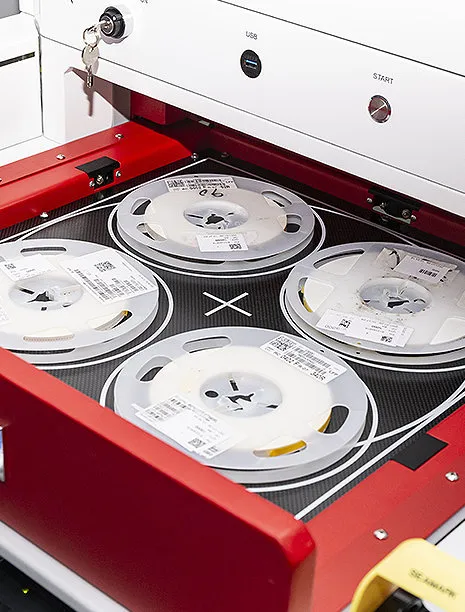
When unused components are returned after an order is completed, the quantity can be checked before the reel goes back into storage.
This creates a more reliable closed-loop inventory process:
Receiving → Storage → Material Issue → Component Consumption → Reel Return → Recount → Restocking
Miniaturization has made component inventory increasingly difficult to manage.
SMD components can be extremely small, and manually separating or visually counting them is impractical when thousands of units are stored on a reel.
High-resolution X-ray imaging provides a way to inspect the reel internally without removing the components from the carrier tape.
Seamark states that its X-ray component counting systems can handle miniature SMD components, including 01005 and 0201 sizes, depending on system configuration. Buyers should validate actual counting performance using representative components before purchasing equipment.
This is particularly relevant for manufacturers working with high-density electronic assemblies where small passive components represent a large proportion of total material consumption.
The appropriate counting architecture depends on inventory volume and automation requirements.
An offline SMD counter is generally suitable for warehouses, laboratories, material verification stations, and businesses that require flexible counting rather than continuous automated processing.
An online reel counter, on the other hand, is designed for higher-volume material handling. It can integrate identification, counting, labeling, and material transfer into a more automated workflow.
Seamark ZM offers dedicated online reel counting equipment within its SMD component counting product range. The company's online solution is designed to automate multiple steps associated with reel identification and counting.
For a factory implementing automated material logistics, online counting can also be connected with other warehouse equipment and digital inventory systems.
Modern component management is moving beyond physical counting.
The real objective is to connect the physical quantity of each reel with its digital material record.
A typical workflow can include:
Barcode scanning → Component identification → X-ray counting → Quantity confirmation → Label printing → Inventory database update
When connected to ERP, MES, or WMS platforms, the counting result can become part of the electronic material record.
This helps manufacturers maintain more accurate information about:
Part number
Reel identification
Remaining quantity
Storage location
Counting time
Material status
Production usage
Seamark's online counting solutions include functions such as automatic code scanning and label processing, supporting a more automated approach to SMD material management.
Choosing an SMD counter machine requires consideration of the actual component and warehouse environment.
Important factors include:
The system should be capable of handling the smallest components in the manufacturer's inventory. Small components may require higher imaging resolution and optimized counting algorithms.
Different applications use different reel sizes. Equipment should support the reel dimensions commonly handled by the warehouse.
Counting accuracy should be tested with actual components rather than evaluated only from general equipment specifications.
High-volume warehouses should consider cycle time and daily reel-processing requirements.
Barcode or QR-code recognition can reduce manual data entry and help associate the physical reel with the correct inventory record.
For automated warehouses, compatibility with ERP, MES, WMS, or other inventory platforms may be critical.
SMD component counting is relevant to a wide range of electronics-related businesses.
Consumer electronics manufacturers may manage enormous quantities of miniature passive components and semiconductor devices.
Automotive electronics manufacturers require controlled material identification and traceability because electronic components are used in safety-critical and high-reliability applications.
Industrial electronics manufacturers often operate high-mix production environments where accurate component inventory is important for flexible production scheduling.
Electronics distributors can also benefit from automated counting when managing large quantities of reels across multiple storage locations.
For these businesses, the purpose of an SMD counting system is not simply to replace manual counting. It is to improve the reliability of the entire material-control process.
Because X-ray technology uses ionizing radiation, safety should be considered when installing an SMD component counter.
Industrial X-ray equipment should incorporate appropriate shielding, interlocks, warning systems, and operational controls. Operators should receive suitable training and follow local radiation-safety regulations.
Manufacturers should also verify equipment certification and documentation for the destination market.
Seamark states that its X-ray counting equipment is designed with safety and international compliance requirements in mind. However, buyers should confirm the exact certifications and regulatory requirements applicable to the selected model and country before installation.
From a quality perspective, counting equipment should also be incorporated into the company's material-control procedures. Regular maintenance, verification, and appropriate record keeping help ensure that counting results remain reliable.
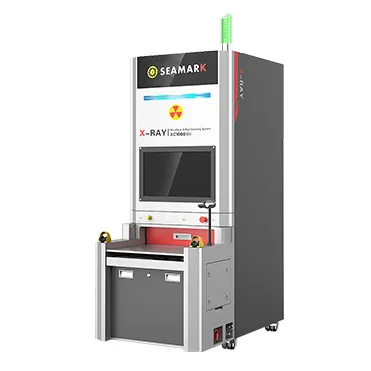
Seamark ZM has developed a dedicated product category for X-Ray SMD Component Counting Equipment, rather than treating component counting as a secondary function of general inspection machines.
Its portfolio includes offline counting equipment as well as online reel counting solutions. The company's broader product range also covers X-ray inspection, automated optical inspection, BGA rework, and other electronics manufacturing technologies.
For B2B buyers, this broader engineering background can be useful when component counting needs to become part of a larger electronics manufacturing or material-management strategy.
Accurate SMD component counting is becoming increasingly important as electronic components become smaller and inventories become larger.
X-ray counting technology provides a non-destructive way to determine the quantity of components inside reels without manually unwinding or opening the packaging. Combined with barcode identification, automated labeling, and digital inventory integration, it can significantly improve material traceability and warehouse efficiency.
For manufacturers and electronics distributors, the right SMD component counter should therefore be evaluated not only by counting accuracy and speed, but also by component compatibility, reel capacity, automation level, system integration, safety, and long-term service support.
Seamark ZM's dedicated SMD component counting solutions provide offline and online options for businesses seeking to improve the accuracy and automation of reel inventory management.
An SMD component counter is a device designed to determine the quantity of surface-mount components stored in reels, trays, or other packaging. X-ray-based systems can count components inside sealed reels without opening the packaging.
An SMD reel counter machine uses imaging technology to detect components inside a reel and software to calculate their quantity. X-ray systems can penetrate the carrier tape, allowing components to be counted without removing them from the reel.
Components can be counted manually, mechanically, or automatically. For large inventories or partially used reels, an X-ray reel counter can provide a non-destructive method for determining the remaining quantity.
An SMD counter can be used for incoming material verification, warehouse stocktaking, production material preparation, partially used reel management, and checking components returned to inventory.
Yes. Certain high-resolution X-ray counting systems are designed for miniature components. Seamark states that its counting equipment can support components such as 01005 and 0201, depending on the equipment configuration and application.
An offline counter normally requires an operator to load and remove reels and is suitable for flexible counting operations. An online counter provides a higher level of automation and can combine reel identification, counting, labeling, and material handling.
X-ray counting is a non-destructive inspection method and does not require the reel to be opened. The equipment itself must be properly shielded and operated according to applicable radiation-safety requirements.
Yes. Depending on the equipment configuration, automated counting systems can support barcode identification, labeling, and communication with digital inventory-management systems such as ERP, MES, or WMS. Integration requirements should be confirmed with the equipment supplier before purchase.
NEXT
 EN
EN
 es
es  ko
ko  de
de  it
it  pt
pt  th
th  ar
ar  pl
pl  vi
vi  tr
tr  ru
ru