
As lithium-ion battery production moves toward higher energy density, thinner electrode layers, and faster production cycles, manufacturers need inspection technologies that can identify internal defects without damaging finished cells. Traditional visual inspection cannot reveal problems hidden inside a battery, making automatic X-ray inspection increasingly important for battery manufacturers.
An industrial X-ray system provides non-destructive imaging of internal structures and can help manufacturers evaluate electrode alignment, overhang, tab conditions, folds, and other hidden abnormalities. Seamark ZM provides X-ray inspection solutions for both winding and stacking battery production, including offline and inline systems.
Battery cells contain multiple layers and components that cannot be completely evaluated through external inspection. A cell may appear normal from the outside while containing misaligned electrodes, abnormal folds, or tab-related defects internally.
X-ray inspection works by transmitting X-rays through the battery and measuring differences in attenuation between materials. The resulting image provides information about internal structures without requiring the cell to be opened or damaged. This makes X-ray technology valuable for process verification, quality control, failure analysis, and production improvement.
For manufacturers, the objective is not simply to obtain an X-ray image. The inspection system should generate repeatable data that can support quality decisions and help identify process deviations before defective cells move to subsequent production stages.
Battery X-ray inspection can be configured for different cell structures and manufacturing processes. Typical inspection targets include:
Electrode overhang and alignment
Plate tabs and tab positioning
Tab folds and creases
Large-area folds
Internal structural abnormalities
Positive and negative electrode alignment
Seamark ZM states that its battery inspection systems are designed to inspect overhangs, plate tabs, tab folds, and large surface folds. Different systems are available for winding and stacking battery technologies.
This capability is particularly important when manufacturers need to control alignment tolerances across large production volumes. Early detection can prevent defective cells from progressing into module or pack assembly.
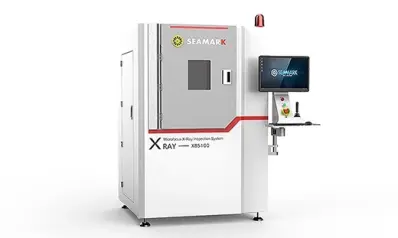
One of the most important decisions when selecting an automated X-ray inspection system is whether inspection should be performed inline or offline.
Offline inspection is generally suitable for laboratory testing, process development, sampling inspection, and smaller-scale manufacturing. For example, Seamark's XB5100 is designed for offline inspection of winding-process batteries and can be used with different battery formats.
In line X-ray inspection, by comparison, is integrated directly into the manufacturing process. It is suitable for high-volume production where inspection results need to be generated automatically without removing cells from the production flow.
For stacking batteries, Seamark's XB7200 supports fully automatic inline inspection and can use TDI line scanning or area-array image acquisition technology. Its inspection parameters include weight, angle overhang, large folds, and tab creases.
The right choice depends on production volume, inspection frequency, takt time, available floor space, and the required level of process automation.
Battery manufacturing involves different cell designs, so there is no single X-ray configuration suitable for every application.
Winding batteries can be inspected using flat-panel detector image acquisition. Seamark offers offline and inline systems for winding-process batteries, including the XB5100, XB7100, XB7300, and XB8100 series.
For stacking or blade batteries, TDI line scanning can provide an effective solution for continuous inspection. The XB5200, for example, is designed for stacking-process cells and uses TDI line scanning technology, with additional inspection capabilities for plate and tab folds.
When evaluating equipment, manufacturers should therefore consider:
1. Cell type and dimensions
2. Winding or stacking process
3. Required inspection parameters
4. Production speed
5. Detector technology
6. Image resolution and contrast
7. Automation and reject handling
8. Data storage and traceability requirements
Modern inspection is moving beyond manual image interpretation. An automatic X-ray inspection system can combine image acquisition, image processing, defect evaluation, and production-line communication.
Seamark ZM uses proprietary image-processing technology on its battery X-ray systems to improve image clarity and help operators evaluate internal battery structures. Some systems are designed for automatic alignment detection and quality classification.
For manufacturers implementing Industry 4.0 strategies, integration is also important. Inspection data can potentially be connected with production-control systems to establish a traceable relationship between individual cells, inspection results, process parameters, and downstream quality information.
This turns X-ray inspection from a standalone testing operation into part of a broader manufacturing quality system.
The X-ray inspection system cost depends heavily on the application. There is no meaningful universal price because battery inspection equipment can range from offline laboratory systems to fully integrated production-line solutions.
Important cost factors include:
X-ray source and tube configuration
Detector type
Required image resolution
Inspection area
Inline or offline architecture
Inspection speed
Automatic defect analysis
Production-line integration
Software and data-management functions
Installation, training, and after-sales support
Therefore, manufacturers comparing X-ray inspection machine price should evaluate total cost of ownership rather than comparing equipment quotations based only on the initial purchase price.
A lower-cost system may be suitable for sampling or R&D, while a higher-investment inline system can be justified when continuous inspection, automation, and production traceability are required.
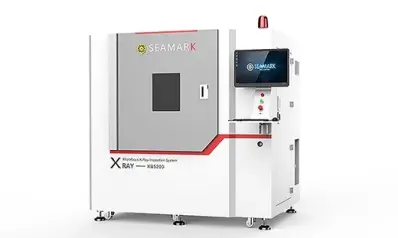
Because industrial X-ray systems use ionizing radiation, safety should be considered during equipment selection, installation, and operation.
Manufacturers should evaluate shielding, interlocks, emergency controls, warning systems, radiation leakage, operator training, and applicable local regulations before commissioning equipment.
Seamark states that its X-ray machines have CE and FDA certifications and that radiation leakage is below 1 μSv/h during operation. Buyers should still verify the exact certification, configuration, and applicable regulatory requirements for the machine and destination country.
Before purchasing an X-ray inspection machine for sale, manufacturers should conduct application-specific testing rather than selecting equipment based solely on specifications.
A practical evaluation should include:
Testing actual battery samples
Defining measurable inspection parameters
Confirming minimum defect-detection requirements
Checking inspection speed against line takt time
Evaluating false-reject performance
Confirming integration with existing equipment
Reviewing radiation-safety documentation
Checking installation and service capabilities
For manufacturers developing new battery lines, involving the inspection supplier early can also reduce integration problems and help determine whether an inline or offline architecture is more appropriate.
X-ray inspection has become an important quality-control technology for lithium battery manufacturing because it provides non-destructive access to internal structures. From electrode alignment and overhang to tab folds and large-area folds, X-ray imaging can identify problems that conventional visual inspection cannot.
For high-volume manufacturing, smt X-ray inspection and automated analysis can provide faster process feedback and better production traceability. For R&D and sampling applications, offline systems offer greater flexibility.
Seamark ZM offers battery X-ray inspection solutions covering both winding and stacking processes, with offline and inline configurations designed for different manufacturing requirements.
X-ray inspection is a non-destructive testing method that uses X-rays to create images of an object's internal structure. Differences in material density and thickness produce different levels of X-ray attenuation, allowing hidden structures and defects to be examined without opening or damaging the product.
An X-ray source sends radiation through the test object toward a detector. Different materials absorb different amounts of radiation, and the detector converts the transmitted X-rays into an image. In battery manufacturing, this image can reveal internal alignment and structural conditions.
Industrial X-ray inspection can be safely operated when the equipment is properly shielded and equipped with appropriate safety controls, interlocks, and monitoring. Manufacturers must also follow applicable local radiation-safety requirements. Seamark states that its systems are designed to meet international safety requirements.
There is no single standard price. X-ray inspection machine price depends on the X-ray source, detector, resolution, inspection area, automation level, software, and whether the machine is integrated into a production line. A customized quotation based on actual battery samples and production requirements is more useful than a generic price range.
Depending on the system and application, X-ray inspection can detect internal alignment problems, electrode overhang, tab abnormalities, folds, and other structural variations. Battery-specific systems can be configured around the inspection requirements of winding or stacking cells.
Offline systems are commonly used for laboratory testing, sampling, R&D, and smaller production environments. Inline systems are integrated with automated manufacturing lines and are designed for continuous inspection at production speed. Seamark offers both configurations for battery applications.
 EN
EN
 es
es  ko
ko  de
de  it
it  pt
pt  th
th  ar
ar  pl
pl  vi
vi  tr
tr  ru
ru