
Accurate electronic component counting is essential for surface-mount technology (SMT) manufacturing. From incoming material inspection to warehouse inventory and production kitting, manufacturers must know how many components are available before releasing materials to the production line. Manual counting and traditional weighing methods can become time-consuming and introduce counting errors, particularly when handling large volumes of small electronic components.
An SMD components counter uses X-ray imaging to estimate the quantity of components inside a reel without requiring operators to count individual pieces manually. For manufacturers managing frequent material movements, an automated SMT counter can help standardize counting procedures, improve inventory visibility, and reduce repetitive workload.
This article compares X-ray counting with traditional counting methods, explains the factors that affect counting performance, and helps SMT manufacturers determine which solution best fits their production and inventory requirements.
An SMD components counter is a device designed to determine the quantity of surface-mount components, commonly supplied on carrier tape and wound onto reels. Depending on the technology, counting may rely on optical sensing, mechanical feeding, weighing, or X-ray image analysis.
An X-ray-based SMD components counter examines the internal arrangement of components within a reel. Image-processing software analyzes the captured data to estimate the component quantity without requiring the operator to unwind and count every component individually.
This approach is particularly useful for electronic components supplied in dense reels, where manual counting would be impractical.
Typical applications include:
Incoming inspection of electronic component reels.
Warehouse inventory verification.
SMT production material preparation.
Counting partially used reels returned from production.
Periodic stocktaking and discrepancy investigation.
Depending on the equipment configuration, an automated counter may also support data recording and integration with existing inventory workflows.
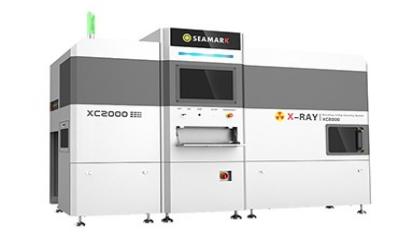
Different counting methods have different strengths. The best choice depends on component characteristics, counting frequency, inventory requirements, and operational costs.
| Evaluation factor | X-ray SMT counter | Weight-based counting | Manual counting |
|---|---|---|---|
| Counting principle | Analyzes X-ray images of reel contents | Estimates quantity from total weight and average component weight | Counts components individually or in groups |
| Handling efficiency | Can count without unwinding the reel | Usually requires weighing and reference-weight data | Often labor-intensive |
| Partial reel handling | Suitable when the reel configuration can be processed by the equipment | Can be affected by component weight variation and tare errors | Possible but time-consuming |
| Component weight variation | Not directly dependent on average component weight | Can influence quantity estimates | Does not depend on weight |
| Operational considerations | Requires suitable imaging and validated counting performance | Requires an appropriate scale and reliable weight data | Depends heavily on operator procedure |
| Best-fit applications | Frequent reel counting and inventory verification | Suitable components with stable weight characteristics | Small quantities and occasional verification |
Neither method is universally superior. Weight-based counting can be practical for suitable components, while manual counting may be adequate for small quantities. X-ray counting becomes particularly attractive when manufacturers handle many reels and need a repeatable process that does not depend on component weight calculations.
Selecting an SMT counter requires more than comparing advertised accuracy figures. Actual counting performance depends on the components, reel condition, image quality, and operating procedure.
Small components packed closely together can create demanding image-analysis conditions. The system must distinguish individual components sufficiently well to estimate the quantity reliably.
Buyers should test the counter using representative component sizes and package types rather than assuming that performance on one reel guarantees equivalent results for every component.
Carrier tape design, pocket spacing, reel dimensions, and component positioning may influence image acquisition and processing.
Damaged tape, irregular component placement, or unusual packaging may require additional validation. Manufacturers should confirm that the intended reel formats are supported by the equipment.
Partially used reels are common in SMT production. They may be returned to the warehouse after a production run, creating uncertainty about the remaining quantity.
An X-ray counter can help verify the remaining components without manually unwinding the entire reel. However, the equipment's suitability should be confirmed for the specific reel configuration and component type.
Mixed reels and nonstandard packaging require particular attention because counting performance depends on the actual arrangement and the system's supported operating conditions.
Before adopting a new counter, manufacturers should compare its results against a verified reference quantity.
Repeated tests can reveal whether results remain consistent under the same conditions. A practical evaluation should include common components, difficult samples, partially used reels, and representative packaging variations.
Accurate counting supports more than warehouse recordkeeping. It also influences production planning, material availability, and purchasing decisions.
Faster material verification: Operators can process reel quantities without manually counting individual components, potentially reducing routine workload.
Improved inventory visibility: More consistent counting procedures help warehouse teams update material records and identify discrepancies.
Better production preparation: Verifying quantities before kitting helps manufacturers determine whether sufficient material is available for planned production.
Simplified partial-reel management: Counting returned reels helps establish more reliable remaining-stock quantities.
More consistent operating procedures: A standardized counting process reduces dependence on individual operator techniques.
These benefits depend on appropriate equipment selection and integration with the manufacturer's existing material management procedures. An X-ray counter does not automatically update inventory records unless the required software or system interfaces are available and configured.
Before purchasing an SMD components counter, manufacturers should assess both technical suitability and operational requirements.
First, identify the component package types, reel sizes, and daily counting volume. This information helps determine whether the equipment can accommodate the intended materials.
Second, establish counting performance requirements. Prepare representative reels with verified quantities and evaluate the equipment under realistic conditions.
Third, consider the workflow. Determine whether counting takes place mainly during incoming inspection, warehouse stocktaking, or production material preparation.
Finally, assess operator usability, result recording, supported data interfaces, maintenance requirements, and technical support.
For manufacturers that primarily count reels at a separate workstation, an offline solution may offer a practical starting point. Businesses requiring counting within a more integrated material-handling process should also evaluate whether an online system fits their workflow.
The terms are often used interchangeably. Both can describe equipment for counting surface-mount electronic components. The actual counting technology may differ, so buyers should confirm whether a particular machine uses X-ray imaging, optical sensing, weighing, or another method.
Many X-ray reel counters are designed to handle partially used reels, but supported configurations vary. Buyers should validate the intended reel sizes, component types, and remaining quantities before purchase.
It depends on the components and operating conditions. X-ray counting avoids estimating quantity from average component weight, while weight-based counting may work well for components with consistent weight characteristics. Representative sample testing is the best way to compare performance.
It can help by providing a more standardized way to verify reel quantities. Inventory accuracy also depends on correct material identification, transaction recording, and synchronization with warehouse management procedures.
Prepare representative reels, verified reference quantities, common component package types, and examples of partially used reels. Define the required counting performance and record the results of repeated tests.
Choosing the right SMD components counter can help SMT manufacturers improve reel-counting efficiency, standardize inventory verification, and reduce repetitive manual work. X-ray counting, weight-based methods, and manual procedures each have their own applications, and the best choice depends on component characteristics and production requirements.
For manufacturers handling high volumes of electronic component reels, an X-ray-based SMT counter is worth evaluating because it can determine quantities without relying on individual manual counts or average component weight calculations. By validating performance with representative samples and selecting equipment suited to the existing workflow, businesses can establish a more reliable and efficient material-counting process.
 EN
 es
 ko
 de
 it
 pt
 th
 ar
 pl
 vi
 tr
 ru