
A useful CT report for a casting should tell you three things: what type of indication was found, where it is in the part, and how large it is in 3D, usually as a position or volume measurement. Read the report against the acceptance criteria agreed for that part. For porosity in European casting CT, BDG P 203 is more commonly used as a reference. Do not read a CT report against ASTM E505 or EN 12681. Those are not CT reporting or CT acceptance-grading standards, and a 2D film grade is not interchangeable with a CT volume measurement.
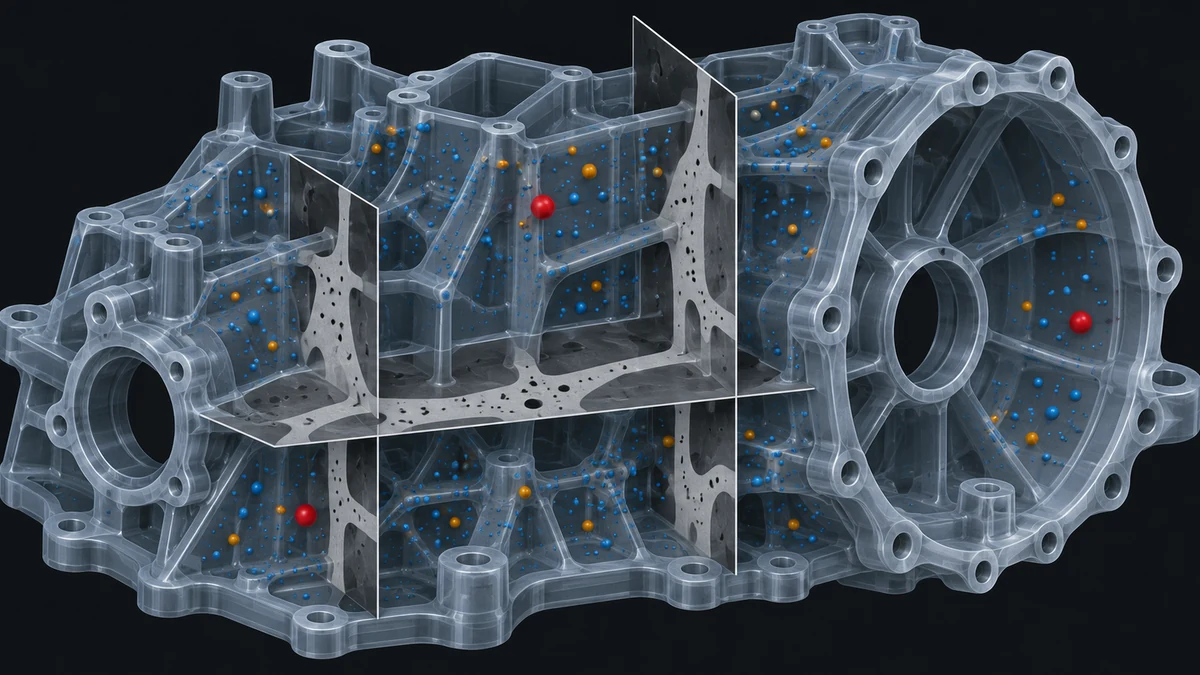
Start with the part identity, the inspected area, and a clear statement that the method is industrial CT, so the result is not mistaken for a 2D radiograph. Then look for the indication type. In casting work, the most common internal findings are porosity, shrinkage cavities, cracks, and lack of fusion; aluminium casting reports may also name sand holes. Next, check the 3D location. An indication in a non-critical region may be acceptable under the agreed criteria, while the same cavity in a sealing face, a thin wall, or a high-stress section may not be. Finally, check size as a 3D measurement, such as volume or extent, according to the agreed inspection plan.
For porosity assessment in European casting CT, BDG P 203 is more commonly used. Use it only when it is the reference named in the customer's inspection plan. Seamark's official website does not state that inspection reports are issued to this or any other named standard.
ASTM E155 is a 2D reference-radiograph standard for aluminium and magnesium castings. ASTM E505 applies only to aluminium and magnesium die castings, and to film. ASTM E2973 is the digital reference-radiograph standard for aluminium and magnesium die castings, and is the reference to use for digital radiography instead of E505. EN 12681 is a process standard for radiographic testing of castings; it is not a defect-grading atlas, and it is not a CT reporting or acceptance-grading standard. None of these should be used as the basis for reading a CT report, and none of them convert a CT volume into a 2D film grade.
This also means a DR result and a CT result are not interchangeable. The XD225 is a digital radiography (DR) system, not an industrial CT machine. An XD225 image is a 2D DR result. When the task is to measure the 3D location or volume of an indication, use industrial CT, such as the XPT8400, and read that CT report against a CT-appropriate reference such as BDG P 203 where that is the agreed method.
Compare each recorded indication with the acceptance criteria named on the drawing or in the quality plan. If no criterion is stated, do not infer a pass or fail from the images or volume data alone. Ask for a trial scan on a representative part when you need to confirm that the chosen CT setup can see the smallest feature of interest.
Typical internal indications include porosity, shrinkage cavities, cracks, and lack of fusion. Sand holes may also be named for aluminium castings.
No. ASTM E505 is a 2D film reference-radiograph standard for aluminium and magnesium die castings. EN 12681 is a radiographic testing process standard, not a defect-grading atlas, and not a CT report or acceptance-grading standard. A 2D grade is not interchangeable with a CT volume measurement.
BDG P 203 is more commonly used. Apply it only when it is specified in the inspection plan.
No. The XD225 is a DR system. A CT report comes from industrial CT, such as a scan on the XPT8400.
 EN
 es
 ko
 de
 it
 pt
 th
 ar
 pl
 vi
 tr
 ru